






Your privacy choices

Booking and estimate requests work without optional tracking. Tracking starts off on each page load. Allow analytics and session replay for this page, or choose advertising separately.

A saved choice never turns tracking on after a reload. Change or withdraw permission using “Privacy choices” in the footer; changing loaded tracking reloads the page with tracking off. Read our privacy notice.

Skip to content
Peak Elevation ExteriorsPlan a roofing visitBook
Colorado EPDM rubber roof systems

EPDM roofing. Details that hold the system together.

Colorado EPDM roofing repairs and replacement estimates. Review membrane, seams, attachment, insulation and flashings for your low-slope building.

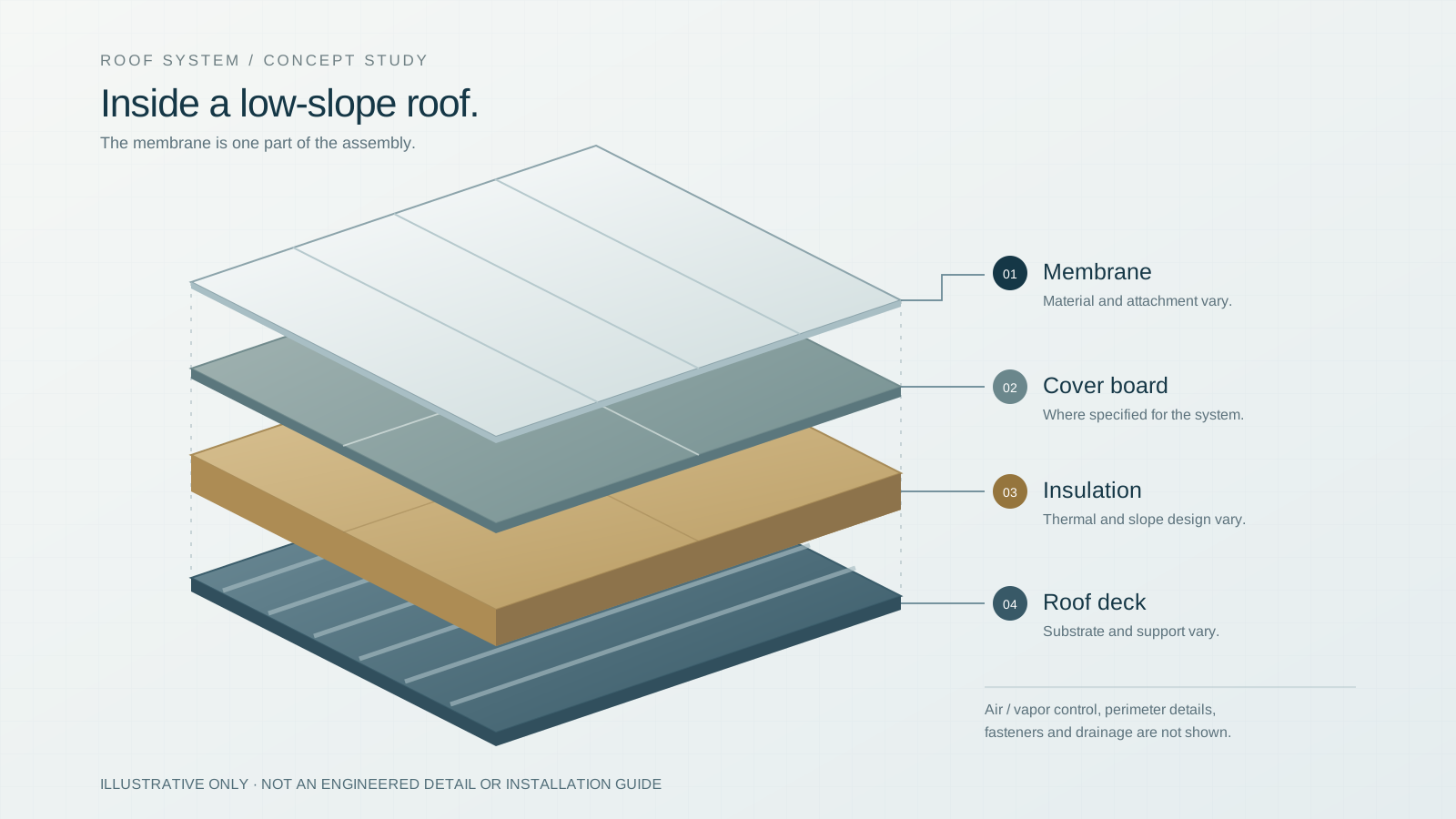
Illustrative low-slope roof assembly with a membrane, cover board where specified, insulation and roof deck. Not an engineered detail.
EPDM system planning: a general low-slope assembly illustration. Not a product photograph or engineered detail.
Material field notes / 06

Flexible membrane. Compatible connections.

An EPDM seam asks different questions from a thermoplastic weld. Preparation, specified splice products and the condition of the existing rubber matter when choosing the repair or replacement scope.

An EPDM splice, in principleIllustration / not to scale
An EPDM splice, in principleA dark rubber-membrane lap is opened to show the position of a compatible splice product and a prepared contact area. This is a seam concept, not a sequence or installation detail. Selected detail: The existing rubber.
01The existing rubberSelect a detail to highlight it

Four details to bring into the conversation

Put the choices side by side

Choose the extent of work from the condition.

Ask for the actual products, scope and terms. Keep open questions with the written estimate.

Choose the extent of work from the condition.
Possible next stepEvidence to establish first
Localized seam repairA serviceable surrounding membrane and an understood cause of separation.
A recover optionRoof layers, moisture, substrate, attachment and applicable requirements.
ReplacementRemoval limits, deck condition and the complete proposed assembly.
Explore roofing materials

The surface you see.
The system beneath.

Get a closer look at shingles, metal, tile and commercial membranes. Rotate a sample, separate its layers and see what goes into the roof.

Roof material studioPreparing sample
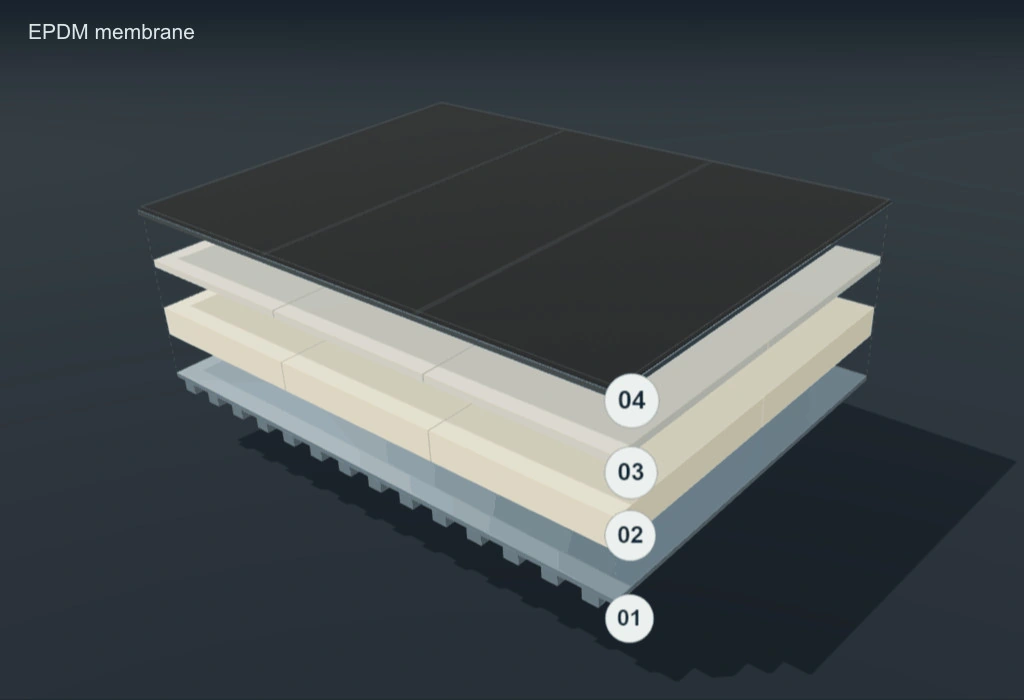
EPDM example roof assembly with four separated layers
Low-slope example assembly

Drag to rotate. Select a numbered layer to look closer.

Commercial / low-slope roofs

EPDM rubber roofing.

A flexible rubber membrane with a characteristic dark finish. Compatible seam tapes, adhesives and flashings connect the roof surface with its perimeter and penetrations.

What we review with you
  • Adhered, ballasted or attached assemblies
  • Compatible seam tapes & flashing materials
  • Deck condition, drainage & edge securement
Explore EPDM roofingDiscuss this material

Simplified example assembly. Not to scale or an installation detail. Actual layers, attachment, flashing, ventilation and drainage depend on the building, selected products and project requirements. Existing roof materials and contaminants affect compatibility.

Roofing manufacturers

More choice for your roof.

Compare products from established roofing brands. Our team helps you choose the materials, colors and assembly for your property.

EPDM roofing / decision studio

A rubber roof needs a compatible repair plan.

The seam, the surrounding membrane and the existing layers are separate parts of the decision. Start with identification and evidence, then compare the extent of work.

Choose the question you need to settle

Compare scope and evidence. This tool does not select a product, calculate a price or establish suitability for your building.

Showing comparison 1 of 3: What makes the proposed seam repair compatible?
Comparison 01 / 03Project variables

What makes the proposed seam repair compatible?

What makes the proposed seam repair compatible? Two scopes or aspects to keep separate; neither column is a universal recommendation.
CheckExisting conditionSpecified repair
IdentifyMembrane, seam type and previous patches.Named, system-compatible splice and flashing products.
PrepareContamination, weathering and contact-surface condition.Manufacturer-specified cleaner and primer requirements.
ExtentSource and limit of the observed failure.Repair boundaries and surrounding-membrane assessment.
Stored only while this page is open
Your discussion list

Questions to ask at your estimate.

Keep the questions that matter to your property. This list stays in this page and is not sent with the estimate form.

Start with “seam evidence” above, then keep the exact question you want answered.

The complete comparison / EPDM roofing

Read the evidence.
Keep the right questions.

Open any question for the full comparison, the source behind it and a request you can bring to your estimate discussion.

01Seam evidenceWhat makes the proposed seam repair compatible?
What to know

Carlisle’s SecurTAPE data specifies compatible EPDM primers and clean contact surfaces. An unspecified tape or coating is not equivalent evidence of compatibility.

Identify
Existing condition

Membrane, seam type and previous patches.

Specified repair

Named, system-compatible splice and flashing products.

Prepare
Existing condition

Contamination, weathering and contact-surface condition.

Specified repair

Manufacturer-specified cleaner and primer requirements.

Extent
Existing condition

Source and limit of the observed failure.

Specified repair

Repair boundaries and surrounding-membrane assessment.

Ask your contractor

Please name the compatible repair products and explain the required surface preparation and repair boundary.

Read the primary sourceCarlisle · EPDM SecurTAPE product data (opens in a new tab)

02Repair or replaceIs the issue isolated or part of a larger assembly problem?
What to know

Carlisle’s current EPDM form specification distinguishes new deck, existing roof and tear-off scenarios. They are different scopes, not interchangeable descriptions.

Findings
Localized work

Condition of the surrounding membrane and transitions.

Broader reroof scope

Existing layers, moisture findings and deck information.

Scope
Localized work

Defined seam, flashing or damaged-area work.

Broader reroof scope

Removal or recover basis, insulation and complete attachment.

Unknowns
Localized work

Record conditions outside the repair boundary.

Broader reroof scope

Record further testing and concealed-condition allowances.

Ask your contractor

Please explain the evidence for localized repair versus a broader reroof, including existing-layer and moisture information.

Read the primary sourceCarlisle · July 2026 EPDM form specification (opens in a new tab)

03Field & transitionsDoes the scope cover the roof interruptions too?
What to know

EPDM splices and a complete EPDM assembly require different documentation. Ask for both the product schedule and the building’s detail schedule.

Schedule
Membrane field

Named membrane, attachment and supporting layers.

Perimeter & penetrations

Curbs, drains, edge metal, walls and pipes.

Match
Membrane field

Specified membrane-to-membrane splice system.

Perimeter & penetrations

Compatible flashing, securement and termination details.

Closeout
Membrane field

Product and actual offered coverage documents.

Perimeter & penetrations

Completed-detail photos and service-access information.

Ask your contractor

Please include a perimeter and penetration schedule alongside the membrane-field scope.

Read the primary sourceCarlisle · July 2026 EPDM form specification (opens in a new tab)

Educational comparison, not an installation detail or an engineering assessment. Current product instructions, the building assessment and applicable project requirements govern the final scope. Source links do not indicate a manufacturer endorsement or installer certification.

EPDM roof condition dossier

Make every existing condition traceable.

EPDM project records need more than a description of a black roof. Document receiving surfaces, moisture questions, attachment interfaces and the repair history that the new work will meet.

Technical reference reviewed

Which existing-roof records help an EPDM assessment?

Collect the original assembly information, repair history and mapped observations before deciding which facts need confirmation.

Read full answer: Which existing-roof records help an EPDM assessment?

Ask the owner for prior drawings, specifications, invoices and any issued coverage documents. Separate a known product identification from a recollection about when the roof was installed. Locate past repairs and equipment changes on a plan. If information is unavailable, say so and identify the investigation needed rather than presenting a guessed assembly as a reliable starting point.

Interview the people who observe the building during leaks or service visits. Record where water appears, which conditions accompany it and what has already been tried. Those observations guide the assessment but do not alone establish entry location or concealed moisture extent. Keep the initial record with later findings so a recommendation can be traced to evidence rather than to the apparent age or color of the membrane.

How should the receiving board and insulation be evaluated for EPDM work?

Identify the specified receiving surface and the condition of the supporting layers within the proposed work area.

Read full answer: How should the receiving board and insulation be evaluated for EPDM work?

An adhered membrane, an attachment layer and the structural deck are separate entries in the assembly. Ask what each new layer will meet and how that surface is accepted. Where existing material is retained, document the assessment and any compatibility or condition questions. Where removal is included, define the exposed-condition review and the process for authorizing corrections before the new layers conceal them.

The board and insulation schedule should identify actual products and their role in the selected assembly. Connect any change in roof height to edge, drain and curb details. Ask for the thermal-review basis rather than assuming a standard thickness answers every building’s requirements. Keep substitutions tied to the appropriate assembly review; an apparently similar board may change the interface the membrane or adhesive was specified to receive.

What does EPDM attachment continuity mean at roof edges and walls?

The field membrane, perimeter and vertical transitions need connected securement and termination documents.

Read full answer: What does EPDM attachment continuity mean at roof edges and walls?

Begin with a roof-plan register of edges, walls, curbs and changes in level. Ask which details apply to each condition and which existing components remain. A general line for membrane installation does not explain every termination. If adjacent construction prevents access, identify the required coordination or unresolved design question before committing to a complete detail scope.

Keep the project attachment basis connected to the actual deck and selected assembly. Product changes or an unexpected substrate can affect more than one detail. Request that accepted revisions be recorded in the final package rather than relying on a verbal field adjustment. The purpose is continuity in the reviewed documents and responsibilities; this notebook does not specify universal fastening patterns, termination dimensions or structural capacity.

How should later equipment and service work be managed on an EPDM roof?

Record access routes and proposed attachments, then coordinate any disturbance of the roof with the applicable system requirements.

Read full answer: How should later equipment and service work be managed on an EPDM roof?

Map the equipment that service personnel must reach and note where tools, hoses or replacement parts will travel. Ask whether compatible walkway or protection products are included and how they relate to drainage. Keep separate the roofing scope and any specialist access or fall-protection design. A convenient route across the roof does not establish that the surface or existing detail can tolerate every service activity.

When another trade plans an opening, support or equipment change, request the detail and responsibility before the roof is disturbed. Retain its location, accepted products and any relevant coverage communication. Update the roof plan after the work. This turns a collection of unconnected service visits into a useful alteration history and helps a future assessment distinguish original work from later changes.

What should closeout show when EPDM work has several repair areas?

Each repair area needs a location, completed scope, product record and any remaining limitation.

Read full answer: What should closeout show when EPDM work has several repair areas?

Use consistent labels from the assessment through the work and final photographs. Record the boundaries of each completed area and the reason it was included. If further issues were found, connect them to the authorization and final work rather than leaving a separate photo folder with no explanation. A clean-looking finished patch is only one part of a traceable repair record.

At handover, identify existing areas outside the work and the maintenance contact for future observations. Keep any applicable inspection records and actual written coverage. If the proposal involved an additional review or manufacturer decision, save that determination rather than assuming it from a product family name. A repair record should explain exactly what changed while preserving an honest account of what was not investigated or renewed.

Compare proposal details
Proposal comparisonAn EPDM condition-to-scope register
Existing evidenceConnect toKeep in the roof file
Assembly identificationDeck, existing layers and selected work limitsSource records and investigation locations
Interface conditionWalls, curbs, edges and drainageDetail reference and responsibility
Attachment reviewActual deck and roof-zone requirementsReviewed assembly and accepted changes
Service historyRepairs, equipment access and later alterationsMaintenance log and actual coverage terms

A record example, not a diagnosis from a photograph or an instruction to repair an unidentified membrane.

These original planning notes explain what to ask and document. They do not diagnose a building, supply an engineered design, set code requirements or establish contractor or warranty eligibility. Confirm the current documents and review responsibilities for the actual project.

Specify the assembly

The visible surface.
The complete assembly.

Connect the selected covering to its supporting layers, attachment and roof-edge details in the written proposal.

YOUR WRITTEN PROJECT SCOPE

EPDM Roofing

01

Materials & agreed work

02

Access, protection & schedule

03

Changes, cleanup & written terms

Use the estimate comparison guide
  1. 01

    EPDM product, thickness and reinforcement

  2. 02

    Deck, insulation and cover-board review

  3. 03

    Specified attachment and perimeter securement

  4. 04

    Compatible primer, seam and flashing products

  5. 05

    Drains, penetrations, curbs and transitions

  6. 06

    Moisture findings, repair limits and warranty terms

Additional work and concealed damage follow the authorization process in your written agreement.

For property owners, managers & general contractors

A proposal your team
can work with.

Plans and measurements support the estimate. Assemblies, quantities, field conditions and exclusions make it useful.

EXAMPLE DELIVERABLE STRUCTURERoofing scope & quantity scheduleExample format · use your project’s measurements
Example roofing quantity schedule format
Scope itemUnitReview basis
Roof area by assemblySFPlans + field review
Perimeter & edge metalLFRoof zones + details
Curbs & penetrationsEADetails + site conditions
Insulation & taperSF / layersAssembly schedule

Drawing revisions · Addenda · Alternates · Exclusions · RFIs

From plan set to project scope.

We use available HOVER and EagleView measurements with drawings, specifications and site information to organize the work. Quantities, waste allowances and pricing assumptions should remain traceable.

  • Roof zones and specified assemblies
  • Access, occupied areas and staging
  • Qualifications, open questions and alternates
  • Agreed closeout and warranty documents
Commercial plans & takeoffs Municipal & public procurement
Have plans or a building to review?

Let’s look at your roofing project.

Send the location, roof information and project timing.

Discuss the project
Roofing questions, answered

EPDM Roofing: your questions.

Have a question about your property?
Talk with our team

Are EPDM seams welded like TPO?

Typical EPDM systems use manufacturer-specified primers and seam tape or other approved splice products rather than TPO-style hot-air welded field seams. Confirm the exact system and repair instructions.

Can an EPDM seam be repaired?

Often a localized repair can be considered after reviewing the membrane condition, contamination, movement and cause of separation. The repair needs compatible materials and preparation, not an unspecified surface patch.

Can I put new EPDM over an old roof?

Recover suitability depends on roof layers, moisture, substrate, attachment and applicable requirements. The proposal identifies the basis for any recover and further investigation needed.

Is black EPDM the only option?

Manufacturers offer different EPDM products and colors, including some white systems. Selection depends on the project, availability, assembly and performance priorities rather than an assumption that every rubber roof is identical.

Let’s talk about your roof

Your building.
Your plans.
Let’s review them.

Send the location, roof information, plans and bid date. Our team will review the package and confirm project fit.

(720) 325-9473

Active leak? Call to confirm availability.

Start your roofing project

Request a project review.

Tell us where and what you need. No obligation.

Add project details, plans or bid date (optional)

Prefer email? Send photos or plans directly.

Call (720) 325-9473 Text us Email us