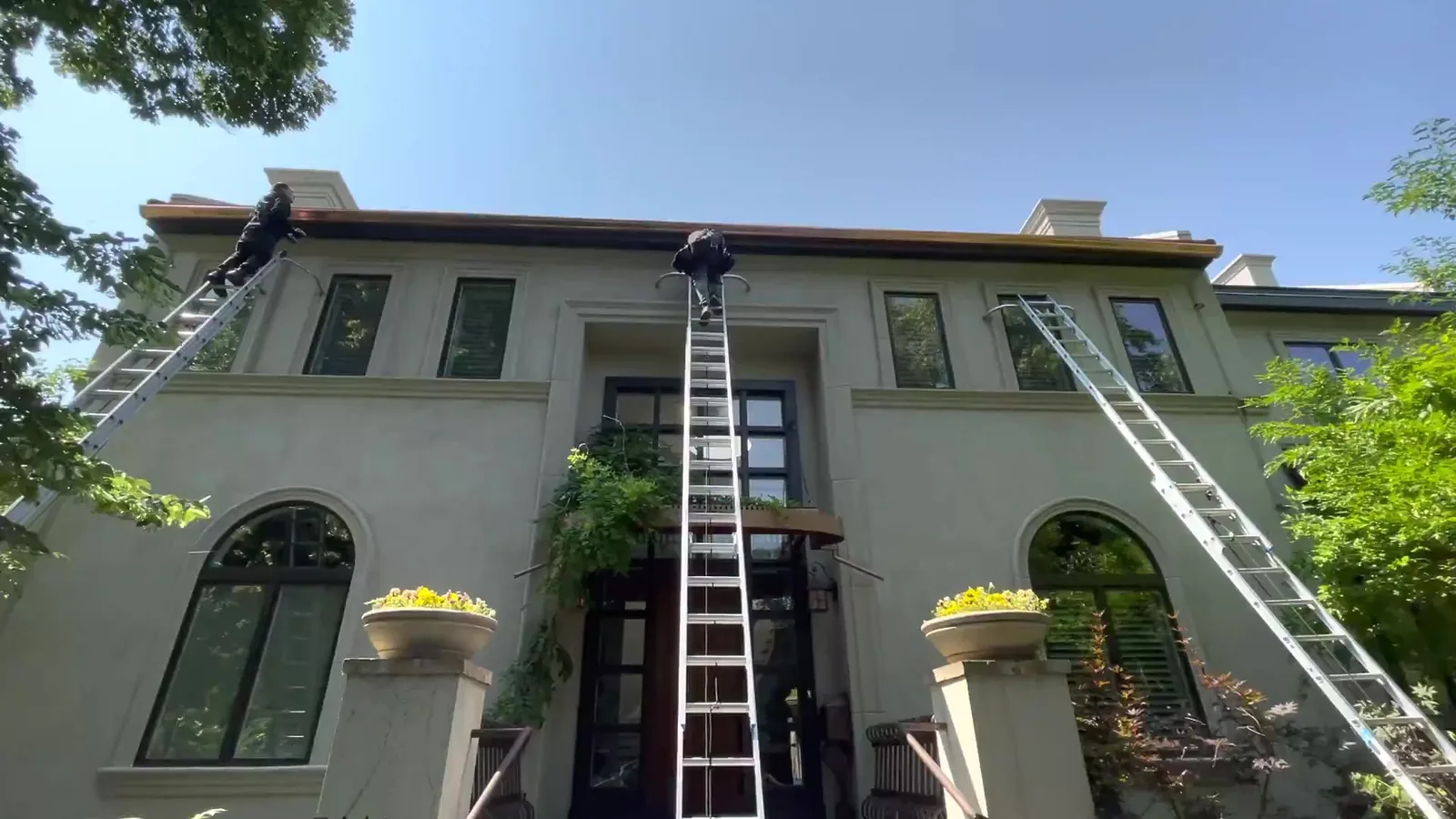
If your Highlands Ranch home was built in the 1980s through early 2000s boom years, there is a good chance the original gutters are still 4-inch K-style — or a short 4-inch sectional system that was never sized for the roof above it. That is not a Highlands Ranch quirk alone. Across the Denver metro, builder packages of that era often prioritized speed and cost, and many of those troughs are still hanging today.
The modern residential baseline is different: 5-inch K-style is what most U.S. homes get as the default seamless profile. Peak Elevation Exteriors installs 5-inch and 6-inch seamless aluminum sized to your actual roof area and pitch — not a one-size habit — and we see the 4-inch upgrade conversation on Highlands Ranch (80126 / 80129 / 80130) walks all season.

Original Peak Elevation Exteriors graphic — navy benefits panel with accurate 4-inch vs 5-inch K-style cut-sheet profiles (~2x trough volume on industry charts).
Why 5-inch became the residential standard
K-style gutters won residential work because the flat back mounts cleanly to fascia and the deeper cross-section carries more water than half-round of the same nominal width. Within that family:
- 4-inch — still sold for sheds, small structures, and legacy installs. Industry capacity charts commonly put it around ~0.6 gallons per linear foot.
- 5-inch — today's residential default. Charts commonly list about ~1.2 gallons per linear foot, and SMACNA-referenced sizing tables treat 5-inch K-style as adequate for large drainage areas at moderate design rainfall (on the order of ~5,500 sq ft of drainage area at a 1 in/hr benchmark — real storms are more intense, so that number shrinks as intensity rises).
- 6-inch — the step-up when roof load, pitch, or chronic overflow says 5-inch is not enough. Roughly ~2.0 gallons per foot in the same industry tables — on the order of 40–67% more volume than 5-inch depending on how you compare the figures.
Those gallon-per-foot numbers are approximate holding volumes, not magic CFM claims. Flow in a storm also depends on slope toward the outlet, how many downspouts you have, and whether the downspouts are big enough. A bigger trough with tiny, clogged, or too-few outlets still overflows.
Why so many Highlands Ranch homes still have 4-inch
Highlands Ranch is a huge master-planned community with tens of thousands of homes built mostly from the late 1980s through the 2010s. Early and mid-boom subdivisions often shipped with builder-grade drainage that looked fine on a dry walkthrough:
- Complex multi-gable roofs that dump concentrated water into valleys
- Upper roof planes that shed onto lower roofs with little or no secondary gutter
- Sectional 4-inch troughs that were cheap to hang at scale
- Downspout counts chosen for curb symmetry instead of roof area
Local gutter contractors across the Front Range report the same pattern in Highlands Ranch, Aurora, Broomfield, and similar boom suburbs: undersized 4-inch (sometimes early 5-inch) systems meeting roofs that are larger and more complex than a 1970s ranch. The gutters did not "wear out" into overflow — they were never sized for monsoon cells and snowmelt pulses.
If your house still has 4-inch troughs and you see water sheeting over the lip with a clean interior, cleaning alone will not fix capacity.
Colorado monsoon + clay = foundation risk
Front Range summer storms are short and hard. A half-inch in twenty minutes is a capacity test, not a gentle soak. Water that overtops the gutter lands at the foundation corner. On expansive clay — common under Highlands Ranch, Centennial, and much of Denver metro — that wet-dry cycle is exactly what foundation specialists warn about: soil that swells when wet and shrinks when dry.
That is the same overflow → clay story we cover in gutter overflow and Colorado clay foundations. Size is half the fix. Discharge distance is the other half — downspouts should carry water 4–6+ feet from the wall onto soil that slopes away. See downspouts & drainage.
4-inch → 5-inch is the first honest upgrade
Replacing a failing 4-inch system with another 4-inch system saves almost nothing and keeps the overflow. Stepping to 5-inch seamless K-style roughly doubles trough volume versus typical 4-inch charts and brings the home into the modern residential baseline. Pair 5-inch with enough outlets (often 2×3 rectangular, or 3×4 when the roof load warrants) and correct pitch toward those outlets.
New seamless gutter systems are priced in a measured, written project quote. Your written quote confirms measured footage, materials, installation, outlets, removal, access, repairs and any applicable charges before you approve the work. Read the new-gutter quote guide.
When 6-inch is the better call than 5-inch
Five-inch is the default residential standard. Six-inch is the right answer when your roof math or history says so:
- Steep pitches that dump water fast into the trough
- Large roof planes or long runs draining to one outlet
- Clean 5-inch systems that still overflow in monsoon cells
- Heavy tree cover where larger 3×4 downspouts clog less and move more water
- Lower-roof catch basins under upper-roof dump zones
We recommend 6-inch from measurement, not from a sales script. If 5-inch is enough, we say so. If valleys and plane size say 6-inch, we quote that — usually with 3×4 downspouts so the trough is not bottlenecked at the outlet.
What to check before you call
- Measure the trough — from fascia back to front lip. Four inches vs five is obvious with a tape.
- Watch one hard storm — overflow with a clean trough = capacity or outlet count, not fluff.
- Count downspouts — long runs with a single outlet fail even when the metal is wide enough.
- Walk the foundation corners — mulch washouts and persistent mud after storms are the clay-side clue.
- Check fascia — soft wood under old hangers needs repair before new seamless goes up.
Bottom line for Highlands Ranch
A lot of south-metro homes still wear 4-inch gutters from the boom years. The modern residential standard is 5-inch K-style; many Front Range roofs with steep pitches or big planes deserve 6-inch. Overflow on Colorado clay is a foundation moisture problem wearing water stains — fix capacity, pitch, outlet count, and discharge distance together.
For a free ground measure in Highlands Ranch, Centennial, Littleton, or Denver, call or text (720) 325-9473, or start on our seamless gutters quote page. Service details also live on /seamless-gutters.