
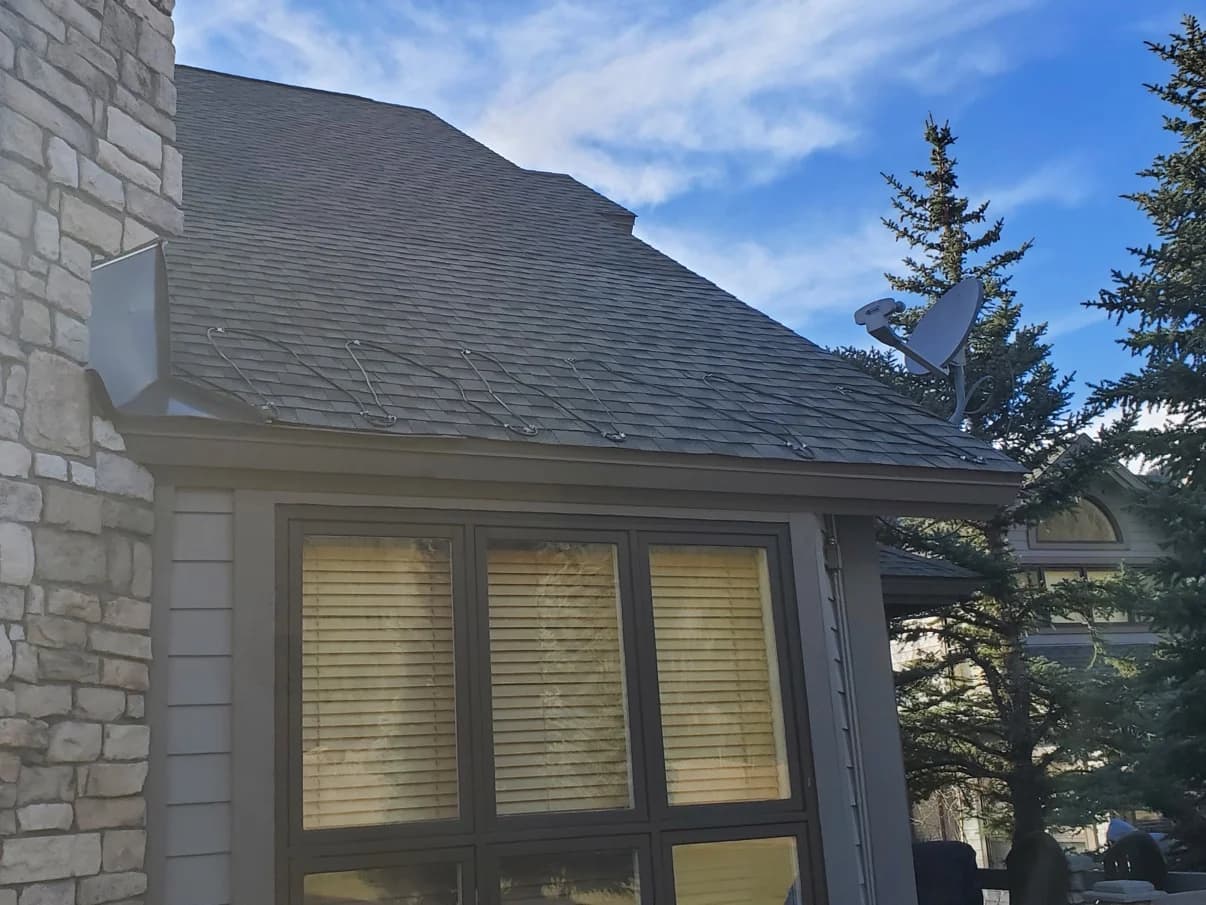
A useful heat-cable inquiry starts with the problem you want reviewed. Repeated ice at a gutter outlet, a leaking roof edge and snow sliding above a doorway may need different investigations. A photo of cable loops on another house does not establish the correct solution for yours.
Use this checklist with Peak's roof heat-cable service information or interactive heating explorer. You can start without exact measurements, provided that estimates and unknowns are clearly identified.
Describe the winter pattern
Explain where ice or water collects, when you noticed it and what happens next. Identify any interior leak, affected entry or recurring downspout blockage. Say whether the condition occurs after snowfall, during a thaw or in another pattern you have observed.
Record observations without climbing onto an icy roof or standing under a loaded edge. If there is active water entry or an immediate falling-ice concern, describe that promptly and limit access to the affected area while arranging appropriate help.
Past photographs and repair records can be useful. They should be treated as background information, not as proof that the same condition or cause is still present.
Separate the purpose from the product
The RAYCHEM roof-and-gutter installation manual describes IceStop as providing drainage paths for meltwater. It expressly excludes using the system to remove accumulated snow, reduce snow load or prevent snow movement. Those distinctions help frame the estimate even if a different manufacturer's product is considered.
Ask what the proposed system is intended to accomplish and what it will not address. A cable proposal should not quietly substitute for investigating unsuitable drainage, a roofing defect or the building conditions associated with ice formation.
If snow sliding is also a concern, raise it separately. Read the standing seam snow-retention planning guide before assuming roof cable and snow guards are alternatives for the same purpose.
Identify the roof-to-outlet route
Provide the roof material, relevant eaves and valleys, gutter arrangement and downspout locations if known. Indicate approximate lengths and heights without undertaking risky measurements. Include where each downspout discharges and whether the outlet connects to another drainage feature.
A sketch can be simple: label the affected section, nearby roof intersections and the outlet. Tell the reviewer about gutter guards, recent roof work or existing heating cable. Unknown roof products or inaccessible outlets should become investigation items rather than guessed material selections.
Flag attachment, access and electrical questions
Roofing materials and gutter details affect how a proposed cable is supported. Ask for the intended mounting approach and whether roofing-product restrictions or existing warranty terms need review. The proposal should identify how work will be accessed and which surfaces need protection.
Report the location of any known outdoor power supply, but do not assume it is suitable. Electrical design, connection, protection and control responsibilities need to be defined by the appropriate professional. Manufacturer product documentation matters: for example, the IceStop data sheet ties that cable to specified connection accessories and protection requirements.
This is not a wiring checklist. Do not select a cable from an internet example and ask someone to connect it without a compatible system design.
Request a complete scope instead of a cable-only number
Ask the proposal to identify the designed area and route, selected cable family, mounting components, connection accessories, controls, sensors and electrical responsibilities. It should distinguish material supply from roof work, electrical work and any separate drainage repair.
Confirm how testing and documentation are handled, what operational guidance you receive, and who to contact if performance is not as expected. Discuss maintenance and any seasonal checks required for the selected product. Keep delivery, access equipment and applicable permits or inspections in the scope conversation.
Send a compact inquiry packet
- Property location and affected areas
- Description of the observed winter problem
- Safe photographs and a labelled sketch
- Known roof, gutter, guard and downspout details
- Approximate dimensions, with uncertain values marked
- Known power-supply location and access limitations
- Previous work, timing needs and questions for the review
Send your heating project to Peak. The first useful result is agreement on what needs investigation and which parts of the system must be included before a reliable installation price can be discussed.